

讓經驗具象,讓 AI 成為員工 Make Experience Tangible, Make AI an Employee
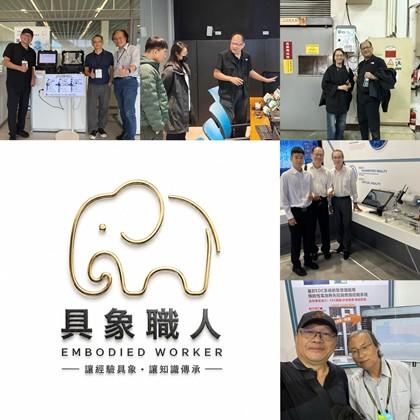
From real equipment and real data to real experience—Embodied Worker works with industry partners to bring AI into the physical world and teach it how to work.
「讓經驗具象,讓知識傳承。」這是具象職人從創立之初就一直相信的事情。
“Make Experience Tangible. Pass Knowledge Forward.” This has been Embodied Worker’s belief from the very beginning.
我們希望 AI 不只是會回答問題,而是能真正走進工業現場,成為企業裡的一名員工。它能理解設備、執行任務、學習工程師與老師傅的經驗,並把一次次工作的過程累積下來,逐步形成企業自己的知識。
We want AI to do more than answer questions. We want it to enter real industrial environments and become part of the workforce—understanding equipment, carrying out tasks, learning from engineers and veteran technicians, and turning repeated work into knowledge that belongs to the enterprise.
但當我們真正往這個方向走,第一個問題很快就出現了:AI 到底要怎麼認識一座工廠?
But as soon as we started moving in this direction, the first question emerged: How does AI actually come to understand a factory?
工廠早已有一套成熟的「反射神經」
Factories Already Have a Mature “Reflex Nervous System”
今天的工廠其實不缺數據。從感測器、PLC、SCADA 到各種上位系統,工業自動化經過數十年的發展,已經形成非常成熟可靠的架構。如果把工廠比喻成人體,這套系統就像非常優秀的反射神經:快速感知、快速判斷、快速反應。
Factories are not short of data. Sensors, PLCs, SCADA systems, and supervisory platforms form a mature and reliable automation architecture built over decades. If a factory were a human body, this infrastructure would be an excellent reflex nervous system: sensing quickly, deciding quickly, and responding quickly.
它們很好地完成了控制、監看、告警與管理的任務。但當 AI 開始成為新的數據使用者,我們開始思考:AI 對數據的需求,會不會和人有所不同?
These systems perform control, monitoring, alarms, and management extremely well. But once AI becomes a new user of industrial data, a new question arises: Does AI need data in a different way from people?
工程師看到一條趨勢曲線,可以結合設備、製程與多年經驗,理解背後可能發生了什麼。AI 如果未來要自己比較事件、理解設備、執行任務、累積經驗,它除了看到結果,可能還需要更完整地知道:數據從哪裡來?事情真正何時發生?之前又發生過什麼?
An engineer can look at a trend curve and combine it with knowledge of the equipment, process, and years of experience to infer what may have happened. If AI is expected to compare events, understand equipment, perform tasks, and accumulate experience, it may need more than processed results. It needs to know where the data came from, when the event actually occurred, and what happened beforehand.
沿著數據,一路往源頭走
Following the Data Back to Its Source
於是,我們從上位系統走向閘道器、控制器,再追到設備與感測端。愈往源頭走,我們愈發現一個值得重新思考的問題:「有數據」,是不是就代表 AI 已經擁有足夠的現場證據?
So we followed the data upstream—from supervisory systems to gateways and controllers, and eventually back to equipment and sensors. The closer we got to the source, the more we questioned a basic assumption: Does having data necessarily mean that AI has enough evidence about what actually happened on site?
光是「時間」就讓我們停下來想了很久。有些時間來自設備,有些來自控制系統內部時鐘,有些則是數據抵達閘道器或資訊系統之後,才被加上系統時間。大家都有 Timestamp,但代表的可能不是同一件事。
Time alone made us stop and think. Some timestamps originate in the device, some from an internal controller clock, and others are added only after the data reaches a gateway or information system. Everyone has a timestamp—but those timestamps may not mean the same thing.
對控制、監看與報表而言,這些時間各有自己的用途,並沒有誰對誰錯。但當 AI 希望理解事件的前因後果時,問題就變得不一樣:哪一個訊號先改變?看到的變化來自設備本身,還是採集與通訊過程?如果這些脈絡沒有被保留下來,AI 看到很多數據,仍可能需要在不完整的資訊上進行推論。
For control, monitoring, and reporting, these different notions of time each serve a valid purpose. But when AI tries to reconstruct cause and effect, the distinction matters: Which signal changed first? Did the change come from the equipment itself, or from the acquisition and communication process? Without this context, AI may still be reasoning from incomplete evidence, no matter how much data it sees.
數據也需要自己的「出生證明」
Data Needs Its Own “Birth Certificate”
這讓我們開始追問:一筆數據從物理現場走到 AI 面前,究竟還保留了多少自己的身分、時間、狀態與來源脈絡?沿著這個問題,我們逐步形成了對數據純度與數據血統的理解。
This led us to ask a deeper question: By the time a piece of data travels from the physical site to AI, how much of its identity, time, state, and source context is still preserved? Following this question, we gradually developed our understanding of data purity and data lineage.
我們所說的「純度」,不是把數據清洗得更漂亮,而是關注數據經過傳遞與轉換之後,還保留多少原來的脈絡。「血統」則像是數據的出生證明,讓重要的工業數據能說清楚:我是誰、從哪裡來、何時發生、經歷過什麼。
By “purity,” we do not mean making data cleaner or prettier. We mean preserving its original context through transmission and transformation. “Lineage” is like a birth certificate for industrial data: it should be able to explain who it is, where it came from, when it occurred, and what it went through.
更重要的是:如果 AI 根據這些數據做出判斷,我們還能不能回到當時重新驗證?因為當企業真的準備把工作交給 AI,遲早會問:「你為什麼這樣判斷?」我們希望未來的工業 AI 不只是給出答案,也能帶著人回到形成答案的數據證據。
Most importantly, if AI makes a judgment from that data, can we go back and verify it later? Once enterprises begin assigning real work to AI, they will inevitably ask: “Why did you make that judgment?” We believe industrial AI should not merely provide an answer; it should be able to lead people back to the data evidence behind that answer.
為 AI 建立新的感知路徑
Building a New Sensory Pathway for AI
這個思考,逐漸形成了我們現在發展的 AI 感知神經系統(ASNS)。如果模型是 AI 的大腦,設備與感測器是神經末梢,那麼 AI 感知神經系統就是我們嘗試建立的一條中樞神經路徑。
This thinking gradually evolved into the AI Sensory Neural System (ASNS) we are developing today. If the model is AI’s brain and equipment and sensors are its nerve endings, ASNS is the central sensory pathway we are building between them.
它不是為了取代 PLC、SCADA 或既有上位系統。成熟的工業自動化繼續做好控制、監看與管理;我們則嘗試建立一條更面向 AI 的感知路徑,讓 AI 更接近現場與原始數據,並保留重要的身分、時間、狀態與來源脈絡。
ASNS is not intended to replace PLCs, SCADA, or existing supervisory systems. Mature industrial automation should continue doing what it does best—control, monitoring, and management—while we build an additional sensory pathway designed for AI, bringing it closer to the physical site and source data while preserving identity, time, state, and source context.
既有系統解決的是它們原本就非常擅長的問題;我們正在探索的,是當 AI 成為新的使用者之後,工業數據是否需要增加另一種面向 AI 的組織方式。這也是我們希望與產業及研究單位共同驗證的問題。
Existing systems solve the problems they were designed to solve extremely well. What we are exploring is whether industrial data needs an additional AI-oriented way of being organized once AI becomes a new user. This is also a question we hope to validate together with industry and research partners.
從現場感知、AI 通信模組到 EDC 邊緣神經中樞與 AI 應用,ASNS 建立面向 AI 的完整感知路徑。簡單來說,它讓數據從誕生的那一刻起,就能被 AI 理解與信任。
From field sensing and AI communication modules to the EDC edge neural hub and AI applications, ASNS creates an end-to-end sensory pathway for AI. Put simply, it is designed so that data can carry the context AI needs from the moment it is created.
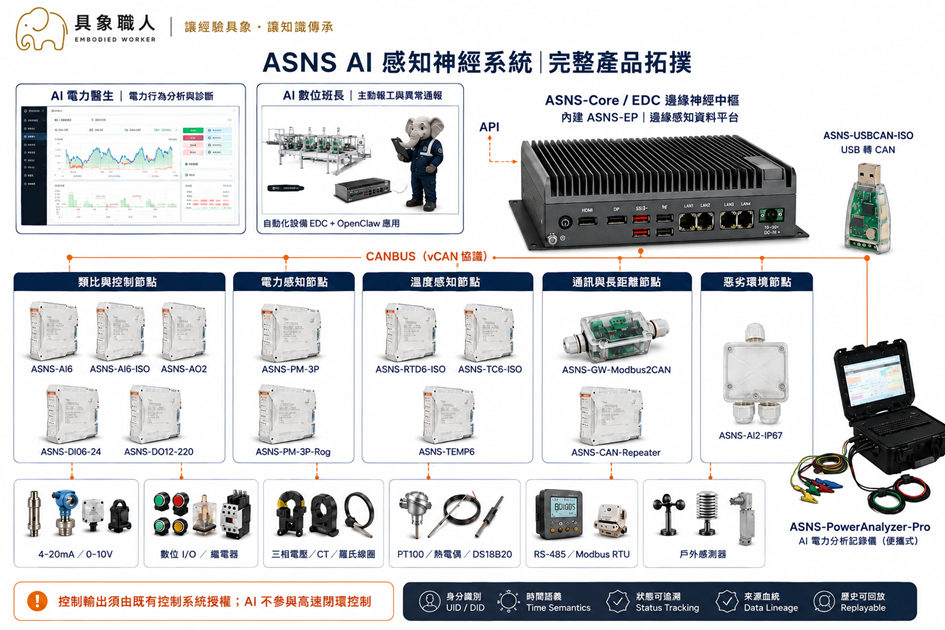
ASNS AI 感知神經系統|完整產品拓撲
ASNS AI Sensory Neural System | Complete Product Topology
從想法走進真實場域
From an Idea to Real-World Sites
我們不是先定義 AI 應該做什麼,再要求所有產業套用;而是走進不同場域,和真正懂現場的人一起教 AI 工作。對具象職人而言,每一次合作都在回答:AI 在這個場域裡,究竟應該看懂什麼、學會什麼、幫上什麼忙?
We do not define what AI should do first and then force every industry to adopt the same template. Instead, we enter different real-world environments and work with the people who truly understand them to teach AI how to work. Every collaboration helps answer the same questions: What should AI understand here? What should it learn? Where can it genuinely help?
在製造業,我們正與一德金屬合作,從製鎖產線出發,共同打造 AI 數位班長,讓 AI 逐步學習設備狀態、現場異常與工作經驗,探索如何協助產線日常管理與異常通報。
In manufacturing, we are working with Yide Metal on a lock-production line to develop an AI Digital Shift Supervisor. The goal is for AI to gradually learn equipment conditions, on-site anomalies, and operating experience, and to explore how it can support daily production management and anomaly reporting.
在能源管理,我們正與淡江大學合作,探索把 EMS 從偏重能耗統計與帳務管理的「會計師視角」,進一步提升到更重視設備運行、能源行為與工程問題的「工程師視角」,讓能源數據不只回答「用了多少電」,也能逐步支援「為什麼這樣用電、下一步可以怎麼改善」。
In energy management, we are collaborating with Tamkang University to explore how EMS can move beyond an “accountant’s view” focused mainly on energy statistics and accounting toward an “engineer’s view” that pays greater attention to equipment operation, energy behavior, and engineering issues. Energy data should not only answer “How much electricity was used?” but gradually help answer “Why was it used this way, and what can we improve next?”
在智慧建築領域,我們也與中國科技大學持續深化 AI 賦能 BIM 的合作,探索如何把 BIM 裡的建築與設備資訊,進一步與現場數據及 AI 結合,讓 BIM 不只描述「建築裡有什麼」,未來也能協助 AI 理解「建築正在發生什麼」。
In smart buildings, we are deepening our collaboration with China University of Technology on AI-enabled BIM. We are exploring how building and equipment information in BIM can be connected with live field data and AI, so BIM can move beyond describing “what is in the building” and help AI understand “what is happening in the building.”
在產學研發方面,正修科技大學採用ASNS系統的AI電力數據分析記錄儀參加2026 JDIE日本設計創意暨發明展榮獲金獎加冕!「應用於電力量測之資料蒐集及管理系統」更獲頒大會金牌及特別獎! 對我們而言,獎項固然是一份肯定,更重要的是讓從設備感知、數據取得到 AI 應用的工程實踐,被更多產業與研究夥伴看見。
In industry-academia R&D, Cheng Shiu University of Technology used an ASNS-based AI power data analysis recorder in the 2026 JDIE Japan Design, Idea and Invention Expo. The project, “Data Acquisition and Management System for Electrical Power Measurement,” received a Gold Medal and a Special Award. For us, the awards are welcome recognition, but more importantly, they helped bring our engineering work—from equipment sensing and data acquisition to AI applications—to the attention of more industry and research partners.
這些合作看似分布在製造、能源、建築與研究領域,背後其實都指向同一件事:讓 AI 更接近真實世界,讓人的經驗能被累積、被學習,最後成為企業可以持續使用與傳承的知識。
These collaborations span manufacturing, energy, buildings, and research, but they all point to the same goal: bring AI closer to the real world, make human experience learnable and accumulative, and ultimately turn it into knowledge that enterprises can continue to use and pass on.
真正的終點,是 AI 員工
The Real Destination: AI Employees
ASNS 仍然只是基礎。具象職人真正想培養的是 AI 員工。
ASNS is still only the foundation. What Embodied Worker ultimately wants to cultivate is the AI employee.
我們把 AI 想成一名剛進公司的新人:模型讓它讀過很多書,但它還不知道這家公司怎麼工作。因此需要工程師帶它認識設備、老師傅教它判斷,讓它開始執行任務;做錯了糾正,完成了驗證。
We think of AI as a new employee. The model may have read many books, but it still does not know how this particular company works. Engineers need to introduce it to the equipment, experienced technicians need to teach it how to judge situations, and it needs to begin performing tasks—being corrected when wrong and verified when finished.
一次任務,就是一次學習;一次處置,就是一個案例。
Each task becomes a learning experience; each intervention becomes a case.
工業現場許多真正珍貴的能力並沒有完整寫在 SOP 裡,而存在於工程師與老師傅二、三十年的判斷與經驗中。人會退休,但企業累積的經驗不應該跟著退休。
Much of the most valuable industrial know-how is never fully captured in SOPs. It lives in the judgment and experience that engineers and veteran technicians build over twenty or thirty years. People retire, but an enterprise’s accumulated experience should live on.
所以我們從最熟悉的電力與設備領域開始,培養第一個具體職種——AI 電力工程師;未來再逐步走向能源、生產、品質、智慧建築,以及更多需要專業經驗的工作。
That is why we are starting in the field we know best—power and equipment—with our first concrete AI role: the AI Power Engineer. From there, we plan to expand gradually into energy, production, quality, smart buildings, and other jobs that depend on professional experience.
從一台設備開始,一起驗證
Start with One Piece of Equipment
進駐 INNOPAD TAIPEI,是我們走進更多真實場域的新起點。我們希望在這裡遇見更多製造業、能源與電力業者、設備商、系統整合夥伴及研究團隊,一起把這些問題放進真實場域驗證。
Joining INNOPAD TAIPEI marks a new starting point for bringing this work into more real-world environments. We hope to meet manufacturers, energy and power companies, equipment makers, system integrators, and research teams who want to validate these questions with us in real operating sites.
不需要一開始就談龐大的 AI 改造,可以從一台關鍵設備、一個真實問題、一項工作開始。用真實場域一起驗證:什麼樣的數據更適合 AI?什麼樣的證據足以支撐 AI 執行不同風險的任務?人類經驗又該如何透過一次次任務,逐步傳承給 AI?
There is no need to begin with a massive AI transformation. We can start with one critical piece of equipment, one real problem, and one task. Together in a real operating environment, we can validate what kinds of data are better suited for AI, what level of evidence is sufficient for tasks with different levels of risk, and how human experience can be transferred to AI through repeated work.
我們始終相信:模型讓 AI 變得聰明,真實數據讓 AI 認識世界,人類經驗教會 AI 如何工作。
We believe that models make AI intelligent, real-world data helps AI understand the world, and human experience teaches AI how to work.
比起讓大家記住具象職人的名字,我們更在意的是:我們提出的問題與方法,能不能成為值得一起驗證的方向?具象職人能不能成為產業走向 AI 時代的一份助力?
More than having people remember the Embodied Worker name, we care about whether the questions and methods we propose are worth validating together—and whether we can become a practical partner as industry moves into the AI era.
「讓經驗具象,讓知識傳承。」對我們而言,這不只是一句標語。從追到數據源頭、探索數據純度與血統,到建立 AI 感知神經系統、培養 AI 電力工程師,我們做的始終是同一件事:讓 AI 學會人的經驗,讓企業的知識繼續傳承。
For us, “Make Experience Tangible. Pass Knowledge Forward.” is more than a slogan. From tracing data back to its source and exploring data purity and lineage, to building the AI Sensory Neural System and developing the AI Power Engineer, we have been working toward the same goal: helping AI learn from human experience so that enterprise knowledge can continue to live on.
聯絡方式 / Contact: pohsun@embodiedworker.com